
What Makes a Diamond Sparkle? Cut Quality Explained
Sparkle comes from cut, not carat weight or color. Learn how proportions control light, and why two identical-looking diamonds perform differently.
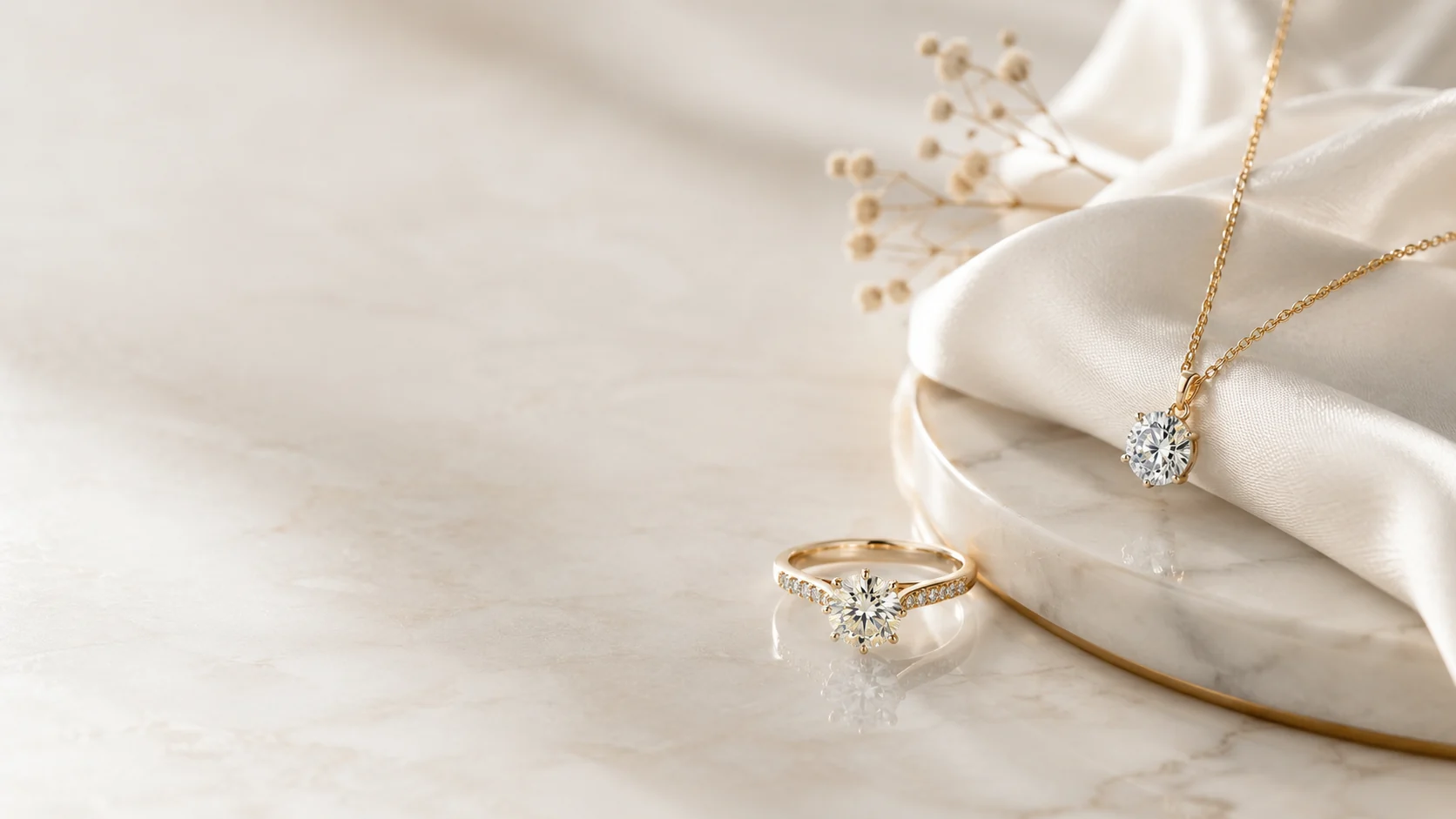
Two diamonds can have the same carat weight, the same color grade, and the same clarity grade, and one of them will visibly outshine the other across a room. The reason is almost always cut.
Cut is the least intuitive of the 4Cs because it is the only one that measures workmanship rather than the raw material. It is also the one that most directly controls the thing people actually want from a diamond, which is the way it behaves in light.
Quick answer: A diamond sparkles because light enters through the top, reflects off internal facets, and returns to your eye. Cut quality — the precision of the stone's proportions, symmetry, and polish — determines how much of that light comes back rather than leaking out. Carat weight, color, and clarity have almost no effect on sparkle.
Three Things People Mean by "Sparkle"
Gemologists break the effect into three components, and it is worth knowing the difference because they trade against each other.
Brilliance is the white light returned to your eye from the stone's interior. It is the bright, lively quality you notice first.
Fire is the way a diamond splits white light into flashes of spectral color — the small bursts of red, orange, and blue you catch at certain angles. This is dispersion, the same effect that produces a rainbow through a prism.
Scintillation is the pattern of light and dark flashes as the stone, the light source, or your head moves. It is the reason a diamond looks static in a photograph and alive in person.
A well-cut diamond balances all three. Pushing proportions to maximize one usually costs you another, which is part of why cut grading exists as a single summary judgment.
How Light Actually Moves Through a Diamond
Light enters through the flat top facet, called the table. It travels down into the stone and strikes the angled facets of the lower half, called the pavilion.
If the pavilion angles are correct, the light reflects off one facet, then another, and exits back through the top toward your eye. That is what you see as sparkle.
If the angles are wrong, the light passes through the bottom of the stone and out the other side instead of reflecting back. This is called light leakage, and it is invisible in the sense that you do not see the light escaping — you simply see a stone that looks flat, glassy, or dark in the middle.
Two classic failure modes illustrate this:
- Cut too shallow, and light escapes through the bottom. The stone can develop a dull, washed-out appearance, sometimes with a visible grey ring.
- Cut too deep, and light escapes out the sides. The center of the stone often looks dark, and the diamond appears smaller from the top than its carat weight suggests.
Both of these can happen to a stone with excellent color and clarity grades. The material is fine; the geometry is not.
What the Cut Grade Actually Measures
For round brilliant diamonds, laboratories assign an overall cut grade — typically running from Excellent down to Poor, and recorded on the stone's grading report — based on a combination of factors:
- Proportions, including table size, total depth, crown angle, and pavilion angle, all relative to the stone's diameter.
- Symmetry, meaning how precisely facets align and mirror each other.
- Polish, meaning the smoothness of the finished facet surfaces.
Symmetry and polish are also graded separately on most reports. Minor deviations in either are usually not visible to the eye, but poor symmetry can misdirect light in ways that show up as reduced brightness.
Why Fancy Shapes Are Different
The round brilliant is the only shape with broad industry consensus on ideal proportions, which is why it is the shape that consistently receives a full cut grade.
Oval, pear, marquise, cushion, and emerald cuts are generally not assigned an overall cut grade by major laboratories. That does not mean cut quality matters less for them — it matters just as much. It means you have to evaluate it more directly, using the proportions diagram, polish and symmetry grades, and your own eyes.
Fancy shapes also have their own characteristic issues. Elongated shapes can show a "bowtie," a dark band across the center caused by the stone shadowing itself. A slight bowtie is common; a pronounced one is a cutting flaw and is worth avoiding.
Practical Advice for Choosing
Prioritize cut over the other three Cs. A well-cut stone with a modest color grade outperforms a poorly cut stone with a top color grade in every real-world lighting condition.
Look at the stone in more than one light. Retail displays use bright, focused spotlighting that flatters almost anything. Daylight and ordinary indoor lighting are more honest tests.
For fancy shapes, look for even light distribution. Move the stone and watch whether the whole surface participates, or whether parts of it stay dark.
Do not chase carat weight at the expense of cut. A slightly smaller, well-cut stone will look better and often appears larger from the top, because its weight is distributed where you can see it.
These principles apply identically to laboratory-grown and mined diamonds. Both are graded on the same cut standards, and cut quality varies within both categories.
Frequently Asked Questions
Why doesn't my diamond sparkle anymore?
The most common cause is surface buildup. Skin oils, lotion, and soap residue coat the stone and block light from entering and returning. Cleaning usually restores the sparkle completely, since the diamond's optical properties do not change with age.
Does a higher clarity grade make a diamond sparkle more?
Not meaningfully. Sparkle is controlled by cut. Clarity affects sparkle only when inclusions are numerous or large enough to interfere with light passing through the stone, which is well below the grades most buyers consider.
What is light leakage?
It is light that passes out through the bottom or sides of a diamond instead of reflecting back to your eye. It results from proportions being too shallow or too deep, and it makes a stone look dull or dark in the center.
Do lab-grown diamonds sparkle the same as natural diamonds?
Yes. Sparkle depends on cut quality and on the material's optical properties, which are identical between laboratory-grown and mined diamonds. A well-cut lab-grown diamond and a well-cut mined diamond perform the same.
Why don't oval and pear diamonds have a cut grade?
There is less industry consensus on ideal proportions for fancy shapes, so major laboratories generally do not assign an overall cut grade to them. Polish, symmetry, and the proportions diagram become the main reference points instead.
If This Is the Kind of Detail You Enjoy
Understanding why one stone outperforms another is what separates useful jewelry advice from sales talk. If people already ask you what to look for, you can open a free CaratShelf storefront and share pieces with the people who trust your eye.
CaratShelf is free to join and use. Registration is reviewed before a seller account is opened.